
What Is Puglia Italy Famous For? The Truth About Burrata

If you ask a casual traveler what Puglia is famous for, they might point to the conical trulli houses of Alberobello, the endless groves of ancient olive trees, or the pristine beaches of the Salento.
They aren’t wrong. But they are missing the soul of the region.
When I take guests on our VIP Winery Vacations tours through the heel of Italy’s boot, the real answer isn’t something you see—it’s something you taste. The true answer is Burrata.
Burrata isn’t just a cheese; it is a story of Puglian ingenuity. It is a “necessary luxury” born from a snowstorm and a refusal to waste precious ingredients. And unlike the durable Pecorino or the aged Caciocavallo hanging in cellars, burrata is fleeting. It demands to be eaten fresh, right now, in the moment.
That urgency alone tells you everything you need to know about the Puglian lifestyle.
The Origin Story: A Snowstorm and a Cheesemaker
The history of Italian food is often romanticized, but the best stories usually start with a problem that needed solving. The story of burrata is no different.
While you won’t find the birth of burrata recorded in dusty government archives, the oral history in the Murgia hills is consistent, specific, and widely accepted by locals as truth.
The Legend of Lorenzo Bianchino
The story takes us to the early 20th century—most sources point to the 1920s or possibly the harsh winter of 1956. A massive snowstorm had descended upon the Murgia plateau near Andria, close to the iconic Castel del Monte.
Lorenzo Bianchino, a cheesemaker working at a local masseria (farmhouse), found himself trapped. The roads were blocked by snow, making it impossible to transport his fresh milk and mozzarella to the markets in the city.
In cheesemaking, time is the enemy. Milk spoils. Fresh mozzarella sours. Bianchino faced a significant financial loss if he couldn’t preserve his product.
Ingenuity Over Waste
Bianchino refused to let the milk go to waste. Drawing inspiration from mantèca—an older method of preserving butter inside a casing of stretched curd—he improvised.
He took the leftover scraps of mozzarella production (ritagli), shredded them into ribbons, and mixed them with fresh cream. To protect this rich, loose mixture, he blew air into a piece of fresh mozzarella curd to form a pouch, filled it with the creamy scraps, and tied it shut.
What started as a preservation method for a poor farmer became one of the most decadent cheeses in the world.
What History Confirms
For those of us who value historical accuracy alongside a good story, here is what food historians confirm:
- Place: Burrata definitely originated in the Andria area of Puglia.
- First Record: It was first mentioned in print in the Guida Gastronomica d’Italia in 1931 as a specialty of Andria.
- Status: In 2016, Burrata di Andria received Burrata di Andria PGI (Protected Geographical Indication) status, officially protecting its production method and geography.
Mozzarella vs. Stracciatella vs. Burrata: Know the Family
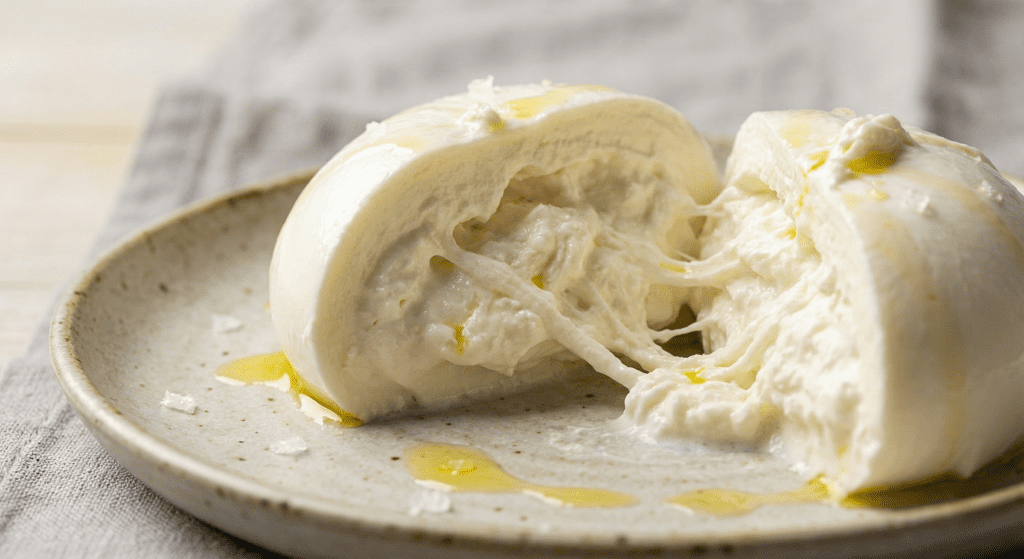
On my tours, I often see confusion between these three terms. To truly appreciate what you are eating, you need to understand the anatomy of the cheese.
Think of them as a family tree where each generation gets richer.
1. Mozzarella
- The Structure: Solid, elastic, and sliceable.
- The Role: This is the “shell” of the burrata. It is pasta filata (spun paste) cheese made from cow’s milk (or buffalo milk). It provides the container.
2. Stracciatella
- The Heart: The word comes from stracciare (“to shred” or “to tear”).
- The Composition: Stracciatella is simply shreds of fresh mozzarella soaked in heavy cream. It is loose, spoonable, and incredibly rich.
- The Trend: You will increasingly see bowls of just stracciatella served on menus, but traditionally, it is the filling.
3. Burrata
- The Package: Burrata is the marriage of the two. It is a solid mozzarella skin wrapped around a liquid stracciatella center.
- The Experience: It offers two distinct textures in one bite—the chew of the skin and the creamy wash of the filling.
How to Spot Authentic Fresh Burrata (Chef’s Tips)
Not all burrata is created equal. With its global popularity, factory-made versions are popping up in supermarkets everywhere. But when you are in Puglia (or shopping at a high-end importer), here is how to spot the real deal.
- The “Head”: Traditional Burrata di Andria often has a distinct “knot” or a gathered closure at the top where it was tied. Some modern producers smooth this out, but the closure should look handmade.
- The Skin: The outer shell should be thin and elastic. If the skin is too thick or rubbery, it’s a sign of poor craftsmanship or an attempt to extend shelf life for export.
- The Cut: When you slice it open, the stracciatella should spill out slowly. If the inside is solid or dry, it’s old. If it runs like water, the cream ratio is off.
- The Aroma: It should smell like fresh milk and grass. Any hint of sourness means it is past its prime.
How to Eat Burrata Like a Puglian (No Gimmicks)

In Puglia, food is religion, and there are commandments. The most important one for burrata? Simplicity.
I have seen restaurants drown burrata in truffle oil, bury it under pesto, or suffocate it with balsamic glaze. Don’t do this. Burrata is a delicate, mild cheese. Strong condiments kill the flavor of the fresh milk. These are the same unwritten rules Italians live by (see our guide on the Unwritten Rules of Italian Food Culture).
The Golden Rule: Temperature
If you take one thing away from this guide, let it be this: Never serve burrata cold.
Cold fat coats the tongue and mutes flavor. You must take the burrata out of the fridge 30 to 60 minutes before serving. It needs to be at room temperature. When the cream inside warms up, the flavor “wakes up.”
The Perfect Serving
Here is the authentic Puglian way to serve it:
- Place the whole ball on a plate.
- Drizzle with high-quality Puglian Extra Virgin Olive Oil (look for the Coratina varietal—its peppery kick contrasts the sweet cream).
- Sprinkle with flaky sea salt.
- Serve with crusty bread (like Pane di Altamura) to mop up the cream.
That’s it. If you want to add an accompaniment, keep it fresh: ripe tomatoes, grilled zucchini, or a slice of prosciutto crudo work well. But the cheese is the star.
In the Glass: The Perfect Burrata Wine Pairings

Burrata is fatty and creamy. In the world of sommelier logic, fat needs acid to cut through it and cleanse the palate.
If you drink a heavy, oaky red wine with burrata, the tannins will clash with the cream, creating a metallic taste. Instead, look for crispness and minerality.
Top Recommendations:
- Puglian White Wines: Look for Verdeca or Fiano Minutolo. These indigenous whites have floral notes and enough acidity to scrub your palate ready for the next bite.
- Southern Italian Whites: A Greco di Tufo or Falanghina from nearby Campania are also stunning matches.
- The Local Rosato: Puglia is famous for its Rosé (Rosato). A Negroamaro Rosato has the structure of a light red but the crispness of a white. It is arguably the most traditional pairing for a summer lunch in Salento.
Experience the Real Puglia
Burrata is a perfect metaphor for Puglia itself: humble origins, incredible ingredients, and a refusal to compromise on quality.
At VIP Winery Vacations, we don’t just point out the sights; we taste the history. When you join us in Puglia, you won’t just learn about Lorenzo Bianchino—you’ll sit at a table in the Murgia hills, watch a master cheesemaker tie the knot on a fresh burrata, and eat it while it’s still warm.
That is the difference between a vacation and an experience.
Curious about other Puglian classics? Read our guide on Puglia’s Famous Orecchiette Pasta to continue your culinary journey.
Frequently Asked Questions About Puglia’s Famous Cheese
Q: Is burrata just creamy mozzarella?
A: Not exactly. Mozzarella is the ingredient used to make the shell of the burrata. The inside is a mixture of mozzarella scraps and fresh cream called stracciatella. So, burrata is a “stuffed” cheese made from mozzarella.
Q: Can you eat the skin of the burrata?
A: Absolutely. The skin is just fresh mozzarella and is meant to be eaten along with the creamy center.
Q: How long does fresh burrata last?
A: Very little time. In Puglia, it is often eaten the same day it is made. If you buy it fresh, try to consume it within 24 to 48 hours. Once cut, it should be eaten immediately.
Q: Why is Puglia famous for food?
A: Puglia is known as the “breadbasket of Italy.” It produces a massive percentage of Italy’s olive oil, durum wheat (for pasta), and wine. Its cuisine is famous for being cucina povera (peasant cooking)—simple, seasonal, and reliant on fresh local produce rather than heavy sauces.
Inspired to travel deeper?
Explore the private wine, food, and producer-led journeys behind the stories on VIP Winery Vacations.
View Apulia


