
High Polyphenol Olive Oil From Puglia: A Chef’s Guide

High Polyphenol Olive Oil From Puglia: A Chef’s Guide
How Coratina, early harvest, and careful milling shape a fresh, peppery oil
High polyphenol olive oil is not a label-driven style. It is fresh extra virgin olive oil from olives with high phenolic potential. Careful harvest and milling protect that character.
Puglia is an ideal place to understand it. Before the plane lands in Bari, you can see the groves: ancient trunks, silver leaves, and red soil. Coratina, early harvest, and disciplined production make a Puglia olive oil green, bitter, and peppery.
That flavor is not a defect to soften away. It is information. Know the olive, harvest date, mill, and producer behind the bottle. Then olive oil stops being a generic condiment. It becomes an agricultural product with a vintage, place, variety, and personality.
Start With Origin, Not a “High Polyphenol” Claim
Key takeaway: A high-polyphenol claim means little without a clear origin, cultivar, harvest date, and producer.
A front label can sound Italian, artisanal, or exceptionally healthy without saying where the olives grew. An Italian flag, brand name, or “bottled in Italy” does not prove the olives were grown there. Some companies buy oil from several countries, blend it, and package it under an Italian brand.
European labeling rules require an origin statement. It must say whether the oil comes from one country or a blend. That statement can be much less prominent than the branding.
The potential for a phenolic-rich oil begins in the grove. When I buy Puglian olive oil, I want olives grown in Puglia and a named producer. I also want the cultivar, harvest period, and milling location. A high polyphenol olive oil should be traceable before it is marketed.
Coratina: A Natural Route to High Polyphenol Olive Oil
Key takeaway: Coratina’s bitter, green, peppery character can signal high phenolic potential, but only lab testing confirms a bottle’s polyphenol level.
Coratina is the Puglian cultivar to know when looking for high polyphenol olive oil. It is named for the area around Corato and strongly associated with Bari and Barletta-Andria-Trani. It produces some of Italy’s boldest oils.
A well-made Coratina can be green, bitter, and peppery. It can suggest fresh-cut grass, artichoke, green almond, herbs, or green tomato. Then comes the sensation at the back of the throat. Sometimes it makes you cough.
That response is not automatically a defect. Bitterness and pungency are positive sensory traits in fresh virgin olive oil. The International Olive Council’s sensory method describes pungency as a biting throat sensation, especially in fresh oils.
A study of Coratina monovarietal extra virgin olive oil describes the cultivar as generally high in polyphenols. Those compounds support bitterness, pungency, and resistance to oxidation. An early-harvest Coratina is a sensible place to look for a phenolic-rich oil.
Still, pepperiness is a sensory clue. It is not a laboratory result or proof of a specific health benefit. Ask the producer for analysis when the actual polyphenol level matters.
Early Harvest Creates the Boldest Oils
Key takeaway: Early harvesting trades volume for sharper green flavor, bitterness, and pungency.
Olives change as they ripen. Early in the season, they are firm and green. They yield less oil, but the oil often has greener aromas, more bitterness, more pungency, and stronger phenolic character. Riper fruit usually yields more oil, with softer and rounder flavors.
That is why some producers advertise a day-one, first-week, or early harvest. They picked the fruit while it was still green. For shoppers, the point is simple: early-harvest oil often tastes greener, more bitter, and more peppery, while later-harvest oil tastes softer and rounder.
Terminology matters here. People still say “first cold pressed,” yet most quality oil now uses centrifugation equipment. Under European rules, “cold extraction” applies only below 27 degrees Celsius, or about 80.6 degrees Fahrenheit.
The real quality questions are:
- How ripe were the olives?
- How quickly were they milled after harvest?
- Was the fruit healthy?
- Was the extraction temperature properly controlled?
- How was the finished oil stored?
A beautiful label cannot fix neglected fruit.
What Makes High Polyphenol Olive Oil Taste Different?
Key takeaway: Puglia is not one flavor. Cultivar, place, weather, and milling choices all shape the oil.
Talking about “Puglian olive oil” as though it has one universal taste is like talking about Burgundy as though it produces one universal wine. It does not.
Puglia stretches between the Adriatic and Ionian seas. Its wine regions are just as varied. Northern Puglia, the Murgia, Bari, Brindisi, Taranto, and the Salento have different soils, elevations, olive varieties, and local conditions.
Around Bari and the BAT provinces, Coratina often gives oil a firm structure, bitterness, and spice. Elsewhere, Peranzana, Ogliarola Barese, Ogliarola Salentina, and Cellina di Nardò offer different expressions. They can be softer, fruitier, or more almond-led.
Dauno, Terra di Bari, Terra d’Otranto, and Collina di Brindisi protect distinct regional identities. An oil produced around Bari can taste completely different from one made 100 miles south in the Salento. That is not inconsistency. That is terroir.
Puglia’s Five DOP Olive Oil Zones
Key takeaway: The five DOPs protect distinct places, olive varieties, and production rules, not a single uniform taste.
Puglia has five protected-designation olive oils. It also has the broader Olio di Puglia IGP:
- Terra di Bari DOP
- Dauno DOP
- Collina di Brindisi DOP
- Terre Tarentine DOP
- Terra d’Otranto DOP
Each designation connects the finished oil to a defined territory, approved olive varieties, and production standards. Terra di Bari can feature Coratina, Cima di Bitonto, or Ogliarola Barese, depending on the area. Dauno, in Foggia, includes Peranzana, Coratina, and Ogliarola Garganica.
Terra d’Otranto is linked to Cellina di Nardò and Ogliarola Salentina. Collina di Brindisi is mainly based on Ogliarola, while Terre Tarentine reflects the olive culture around Taranto. The DOP system does not say every bottle tastes identical. It protects differences that are real and worth preserving.
The Soil and Microclimate Matter
Key takeaway: Puglia’s soil and climate matter, but cultivar and producer choices finish the story.
Puglia’s limestone, clay, and red soils affect tree growth, water drainage, and fruit development. Its long, narrow geography also changes exposure, wind, rainfall, and distance from the sea. Terroir is not just dirt.
Olive oil quality comes from olive variety, climate, soil, water, fruit maturity, and extraction. That mix creates many Puglian styles, not one fixed profile. Coratina can taste different across Puglia because the tree responds to its environment. The producer then decides when to harvest and how to make the oil.
Ancient Trees Give the Landscape Its Soul
Key takeaway: Ancient trees carry cultural value, yet freshness and careful production still determine the quality in the bottle.
Puglia’s monumental olive trees are part of the region’s environmental, historical, and cultural identity. Age alone does not guarantee an exceptional oil, but these trees still matter. They connect the land to families who have cared for it across generations.
At Masseria Amastuola near Taranto, where we stay during our journeys, olive trees stand just outside the property. The setting makes the link between agriculture, hospitality, and place impossible to miss. I remember waking up there and seeing those enormous old trees. It feels less like a hotel stay and more like sleeping inside the story.
That moment explains Puglian olive oil better than any tasting note ever could.

Xylella Changed the Landscape
Key takeaway: Xylella is both an agricultural crisis and a lasting cultural loss for Puglia’s olive landscape.
No honest discussion of Puglia’s olive trees can ignore Xylella fastidiosa. The bacterium was first detected on olive trees in southern Puglia in 2013. It has devastated groves, especially in the Salento, and reshaped the region’s agriculture.
This is not just an agricultural crisis. It is also a cultural and environmental loss. Families lost groves that had been part of their lives for generations, and ancient landscapes changed. Producers have had to rethink varieties, farming practices, and olive growing.
Puglia is protecting ancient trees while rebuilding parts of its olive economy. That work will change the region’s flavor map. Olive oil is never frozen in time.
How I Properly Taste Olive Oil
Key takeaway: Taste oil straight and warm it gently before judging its fruitiness, bitterness, and peppery finish.
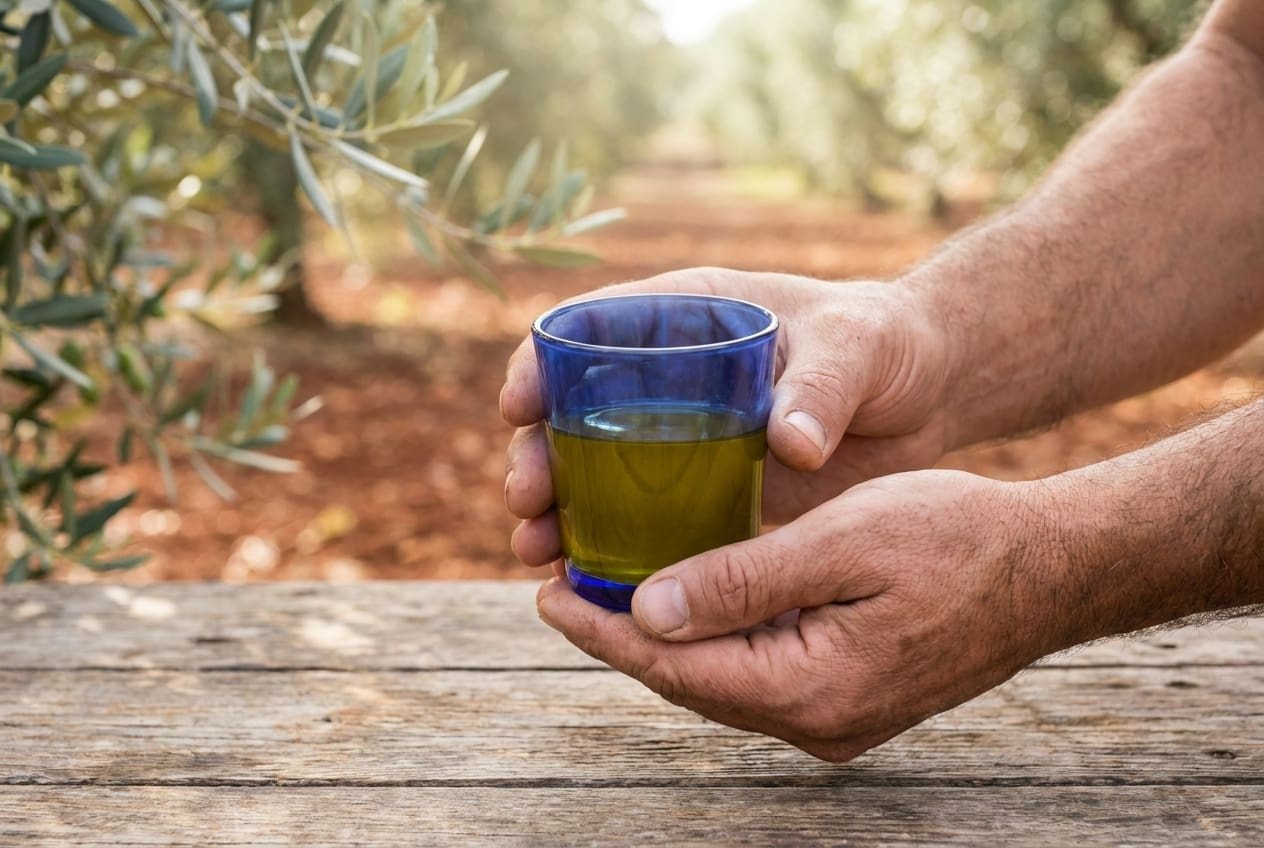
Bread Is for Love. A Spoon Is for Truth.
I love fresh bread with great olive oil. But I do not begin with bread when I am judging an oil.
Bread absorbs oil and brings its own flavor. To understand the oil, I taste it straight.
Here is my process:
- Pour a Small Amount
- Warm It Gently
- Smell Before Tasting
- Take a Small Sip
- Look for Defects
- Reset Your Palate
Is High Polyphenol Olive Oil Healthier?
Key takeaway: High polyphenol olive oil needs lab testing for confirmation. Pepperiness is a useful sensory clue, not proof by itself.
Early-harvest oils often contain more phenolic compounds than oils from fully ripe fruit. Those compounds help explain bitterness and pepperiness in oils such as Coratina. Researchers have also examined olive-oil phenolics, including oleocanthal.
Consumers should be careful with sweeping claims. Pepperiness is a sensory indicator, not a chemical analysis. The EU’s authorised olive-oil polyphenol claim applies only to oils that meet a defined hydroxytyrosol threshold and daily intake condition.
A great extra virgin olive oil must also be fresh, properly made, stored well, and free from sensory defects. The healthiest bottle is not automatically the one that burns the most. Quality is about balance, authenticity, and freshness, not a contest to see which oil makes you cough hardest.
Why Olive Oil Always Tastes Better in Puglia
Key takeaway: The strongest tasting memories join flavor to a producer, a grove, and a shared table.
Fresh oil matters. Native varieties matter. Soil, early harvest, and extraction methods also change the flavor. But eating and drinking are shaped by the setting, too.
Wine tastes different when you sit with the winemaker. Olive oil tastes different when you stand in the grove with the producer. You see the soil, touch the tree, and smell fresh-cut grass and herbs. You understand that the person pouring the oil may have harvested those olives only months earlier.
The flavor becomes connected to a face, a family, and a place. That is what we create on VIP Winery Vacations journeys. We do not simply tell you which oil is bitter, fruity, or peppery. We bring you into the place that created it and share the unwritten rules of Italian food culture that make a shared table matter.
Frequently Asked Questions About High Polyphenol Olive Oil
Key takeaway: Start with cultivar, harvest, origin, and freshness when choosing a Puglian extra virgin olive oil.
Why is high polyphenol olive oil often peppery?
Many Puglian oils use bold native varieties such as Coratina.
Early harvesting also tends to increase bitterness, green flavor, and peppery pungency.
What does Coratina olive oil taste like?
Coratina can taste grassy, herbal, bitter, and intensely peppery.
It can suggest artichoke, green almond, green tomato, or olive leaf.
Does a peppery finish mean the olive oil is fresh?
Pungency is a positive trait often linked to fresh, early-season oil.
Taste alone cannot confirm an oil’s age, chemistry, or storage history.
Is all Italian olive oil made from Italian olives?
No. Some oils bottled or branded in Italy are blends from other European or non-European countries. Read the bottle’s country-of-origin statement rather than relying on the name or design.
What does early-harvest olive oil mean?
It means the olives were picked while still green or beginning to ripen. Early-harvest oils are generally more bitter, peppery and herbaceous than oils made from riper olives.
What is the difference between cold pressed and cold extracted?
Traditional pressing is now less common. Most modern quality oils use centrifugation.
Under European labeling rules, “cold extraction” means the oil was obtained below 27 degrees Celsius.
How should I taste olive oil?
Taste it straight from a small glass or spoon, warmed gently to approximately 80 to 82 degrees Fahrenheit. Smell it first, then sip and draw in air to experience its fruitiness, bitterness and pungency.
What are Puglia’s five DOP olive oil zones?
They are Terra di Bari, Dauno, Collina di Brindisi, Terre Tarentine and Terra d’Otranto. The region also has the broader Olio di Puglia IGP designation.
Where can travelers experience olive oil in Puglia?
The best experiences happen at working estates, small mills and family-owned farms where guests can walk through the groves, meet producers and taste oils close to where the olives were grown.
Come Taste Puglia at Its Source
Key takeaway: The clearest way to understand Puglia olive oil is to taste it where the olives were grown.
Reading about Puglian olive oil is one thing. Flying over the groves is another. Standing under an old olive tree and tasting fresh Coratina from a spoon changes your understanding. That is the difference between consuming a product and experiencing a place.
Join VIP Winery Vacations for chef-led Puglia food tours and gastronomy tours. Explore our Puglia and Basilicata journey to experience the region at the table and in the grove. For another local variety, read our guide to Malvasia Bianca.
From intense Coratina to early-harvest oil, tasting shows why Italian extra virgin olive oil tastes distinct. A Puglia olive oil can be high in polyphenols, but only lab analysis confirms that claim. Our olive oil tasting in Puglia focuses on flavor, freshness, and the people behind each bottle.
High polyphenol olive oil makes more sense when you taste it in the grove, at the producer’s table, and in the place that made it. High polyphenol olive oil is not about chasing the harshest burn. It is about choosing fresh, well-made oil with a clear origin and a producer who can explain it.
Inspired to travel deeper?
Explore the private wine, food, and producer-led journeys behind the stories on VIP Winery Vacations.
View Apulia


