









Italian food culture does not announce itself loudly.
It reveals itself gradually—ticking by in the background like a metronome you don’t notice until you fall out of step.
If you spend enough time here—not rushing between landmarks, but actually living inside a neighborhood—something becomes clear. It isn’t abundance that defines Italian food culture.
It’s restraint.
In America, we’ve normalized constant grazing. Hunger is treated like an emergency. A warning light that must be silenced immediately with a protein bar, a coffee the size of a small bucket, or whatever fits in the cup holder. We eat in cars, at desks, while walking, while scrolling. We fuel the machine the moment it flickers.
Italy operates on an entirely different frequency. Here, the rhythm matters more than the recipes. The when matters just as much as the what.
I remember one of my early trips, long before wine tours or itineraries—just me, a small town, and too much curiosity. It was late morning, somewhere between breakfast and lunch, and I made the rookie mistake of assuming hunger meant it was time to eat. I wandered into a bar and asked what food they had.
The bartender looked at me, smiled politely, and said, “Pranzo.”
Lunch.
Not now. Not soon. Just… lunch.
He poured me an espresso instead. No menu. No options. No apology. I stood there, drank it in three sips, and watched locals come and go—no snacking, no impatience, no searching for something to hold them over. Hunger wasn’t a problem. It was simply information. A signal that lunch was coming, and that it would be better because of the wait.
That moment stuck with me.
To eat like an Italian is to master the art of the pause. It is a discipline that respects digestion as much as flavor—a mindset that gave rise to the global Slow Food movement, emphasizing awareness over speed. To understand it, you must stop looking at the menu and start looking at the clock.
To understand Italian food culture, you have to stop staring at the menu and start watching the clock. Here is how the day truly flows—from the first quiet espresso to the final glass that closes the night.
Morning: The Whisper, Not the Statement
(7:00 AM – 10:30 AM)
In many parts of the world, breakfast is marketed as the most important meal of the day. It is a production—eggs, stacks of pancakes, protein bowls, a frantic attempt to front-load energy.
In Italy, breakfast is not a meal. It is a gesture.
It exists for one purpose only: to wake the body gently, not to weigh it down. The goal is stimulation, not saturation. Appetite is meant to stretch forward into the day, not collapse under the weight of early digestion.
The Ritual of the Bar
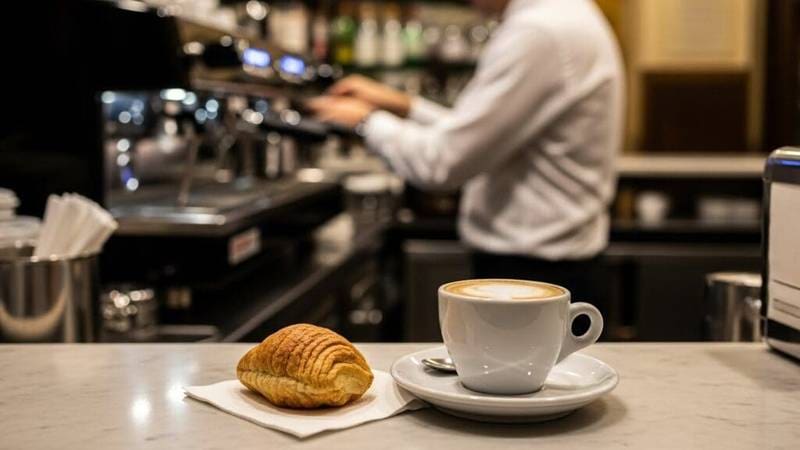
Walk into a bar at 8:00 AM and you won’t see laptops, playlists, or people settling in for the morning. What you’ll see instead is choreography.
You pay first at the cassa, receipt in hand, then slide over to the bar. A nod. A word. The coffee lands. The pastry follows. Most people are finished in under five minutes.
Breakfast is often eaten standing up—not out of haste, but out of intention. This is not a moment to linger. It’s a brief reset before the day asserts itself.
The Components
- Cappuccino or Caffè Latte: This is the only time of day when milk-heavy coffee is culturally acceptable. Milk in the morning is viewed as gentle nourishment—a soft coating for an empty stomach, not a digestive challenge.
- Cornetto: Often mistaken for a croissant, but fundamentally different. A cornetto is softer, less laminated, and far less butter-forward. Where a croissant shatters and flakes, a cornetto yields. It’s lightly sweet, more dough than fat, closer to brioche in spirit than puff pastry in construction. It comforts rather than impresses. That difference matters. This is not a pastry meant to dominate the morning—it’s meant to disappear quietly alongside coffee.
- Biscotti or Fette Biscottate: At home, breakfast is often even more restrained: hard cookies or toasted bread with jam. Simple. Dry. Predictable.
There are no savory plates. No eggs. No bacon. Salt belongs to later in the day.
Cultural Truth: The Logic of Digestion Visitors often ask why the cappuccino rule feels so absolute. Why ordering one after lunch earns a raised eyebrow, or a smile that says you’re not from here.
It isn’t snobbery. It’s physiology.
Rule: Milk is considered a meal in itself. It is dense, complex, and slow to digest. To an Italian, drinking warm milk after a full lunch is like putting a lid on digestion—it interferes with the body’s natural process.
Milk belongs only in the morning, when the stomach is empty and receptive.
The day begins clean. The appetite is awakened—but deliberately not satisfied. The hunger you feel by late morning is not a mistake. It’s part of the design.
Mid-Morning: Espresso, Not Snacks
(10:30 AM – 12:00 PM)
By late morning, the atmosphere of the bar shifts. The soft scent of warm milk disappears, replaced by the sharp, roasted edge of espresso.
Order a cappuccino now and you’ve announced yourself as a visitor. The window for milk has closed. The stomach is awake, and the Italian response is not to coat it again—but to move it forward.
The Role of Espresso
At this hour, coffee is purely functional.
It is an espresso—un caffè—taken standing up, in two or three sips. It is not something you carry. It is not something you stretch out over time. You don’t walk the street with it in your hand.
Espresso here functions like punctuation. A clean pause. A reset. A sharp intake of focus before the sentence continues. You drink it, you finish it, you move on.
The Missing Snack Culture
Walk through an Italian city at 11:00 AM and what stands out most is what you don’t see.
No to-go cups. No adults eating protein bars while walking. No bags of chips crinkling at desks.
The idea of grazing—eating constantly to manage energy—simply doesn’t exist in the same way. Food is not background noise. It has a place, and a time.
From the Italian perspective, constant snacking disrupts rhythm. If you are always eating, you are never truly hungry. And if you are never truly hungry, lunch loses its purpose.
Cultural Truth: Hunger as a Signal In America, hunger is often treated like a malfunction—something to correct immediately. In Italy, hunger is welcomed. It’s allowed to arrive on its own. It builds anticipation. It sharpens the palate.
Rule: Hunger is not an emergency. It’s a signal that the day is unfolding correctly.
By skipping the mid-morning snack, the palate stays clean. The appetite focuses. The body prepares itself for what matters most.
Lunch is coming—and it should be met with intention.
Lunch: The Anchor of the Day
(12:30 PM – 2:30 PM)
If breakfast is a whisper, lunch is a statement. It is the anchor that holds the Italian day in place.
In cities like Milan or Rome, the legendary long lunch has shortened, but its purpose remains unchanged. Lunch is not something you squeeze between emails. It is a protected block of time where the day pauses.
In smaller towns, this pause is literal. Shops close. Shutters come down. Streets go quiet.
The message is unambiguous: Work stops for food. Food does not accommodate work.
Decoding the Sequence: The Structure of the Meal
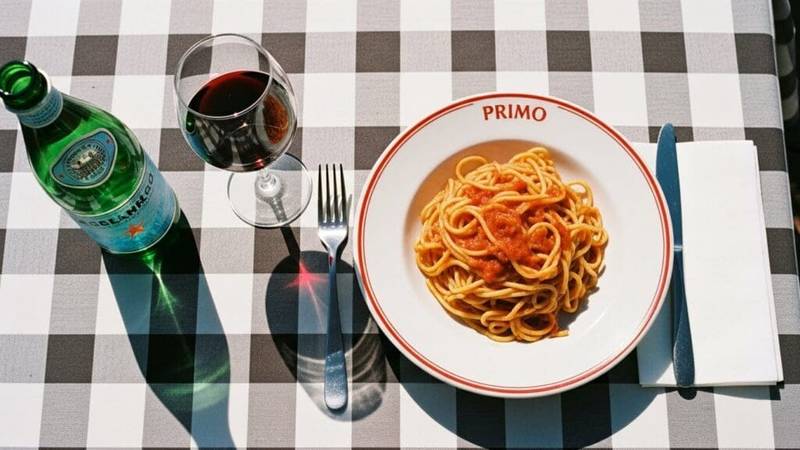
Italian menus are organized around a clear hierarchy. Understanding this structure—more than knowing what to order—is what allows you to eat with confidence.
You are never expected to order everything. You are expected to respect the order.
- Antipasto (The Opener): Cured meats, cheeses, marinated vegetables. Designed to wake the palate, not to satisfy hunger.
- Primo (The First Course): Pasta, risotto, or soup. This is the carbohydrate course, and it stands on its own. It is never a side dish.
- Secondo (The Second Course): The protein—meat or fish—served alone, without distraction.
- Contorno (The Side): Vegetables or salad, ordered separately to accompany the secondo. It does not automatically arrive with your steak.
The Golden Rule of Ordering
You do not need to order all four courses.
A very common lunch is just a primo. Equally common is a secondo with a contorno.
What matters is not quantity—it’s sequence. You don’t order pasta with your steak. One course follows the other. Even when you eat lightly, the structure remains intact. This is restraint without deprivation.
Wine: The Moderate Companion
Wine at lunch is normal—but it is never the point.
A single glass of Barbera or a simple white is treated like seasoning. It belongs to the food, not the mood. The goal is enhancement, not intoxication.
(For a deeper look at how wine aligns with regional pace and purpose, see our guide to Piedmont Wine Tasting Tours.)
Cultural Truth: The Sacred Pause This structure exists for a reason. It forces you to sit. You cannot eat spaghetti while walking to a meeting. You cannot cut a steak while answering emails.
Rule: Lunch supports work by creating a true break. It does not interrupt productivity—it restores it.
The food is warm. The portions are reasonable. The pace is calm.
When you return to the world around 2:30 PM, you’re not dulled by excess. You’re steady. Focused. Ready.
Afternoon: The Quiet Digestion
(3:00 PM – 5:00 PM)
The hours after lunch are often the most disorienting for visitors. Streets empty. Museums grow quiet. A collective stillness settles in.
This isn’t laziness. It’s biology—respected, not resisted.
The afternoon is reserved for digestion. The meal hasn’t ended simply because the plate was cleared. The body is still working.
The Missing “3:00 PM Slump”
In the American workday, three o’clock is often a moment of crisis. Blood sugar drops. Energy fades. The search begins—for candy, coffee, or another hit of stimulation.
In Italy, that panic is largely absent. Lunch was substantial, but not excessive. Wine, if present, was measured. The result is not a crash, but a slow, steady processing. The body isn’t asking for rescue—it’s asking for quiet.
The Ritual of the Second Coffee
If anything is consumed during this window, it is minimal and deliberate.
- Un caffè: A second espresso may appear—not to feed hunger, but to sharpen the mind for the later hours of the day.
- Merenda: A small snack—fruit, bread with olive oil, or something simple—exists primarily for children returning from school. It’s nourishment for growing bodies, not a way for adults to fill time or boredom. Most adults abstain.
There are no bowls of candy. No grazing. No unconscious eating. The body is left alone to do the work it has already begun.
Rule: Stillness is part of the meal. Digestion is an active process, and it requires peace—not constant interruption.
This discipline of waiting isn’t deprivation. It’s preparation.
Because when the afternoon gives way to evening, the body is ready for the next deliberate moment of the day—the aperitivo.
Aperitivo: The Bridge Between Day and Night
(5:30 PM – 7:30 PM)
If lunch is the anchor, aperitivo is the hinge. It’s the mechanism that closes the workday and opens the evening.
But aperitivo is not “Happy Hour.”
In the American model, Happy Hour is about decompression. It’s designed to dull the day—cheap drinks, heavy appetizers, and enough food to blunt the appetite for dinner. It’s an ending.
In Italy, aperitivo is the opposite. It’s preparation.
The word comes from the Latin aperire—to open. Its purpose is physiological and social at the same time. Aperitivo wakes the appetite, sharpens the senses, and gently shifts the body from work into connection.
The Rules of Engagement
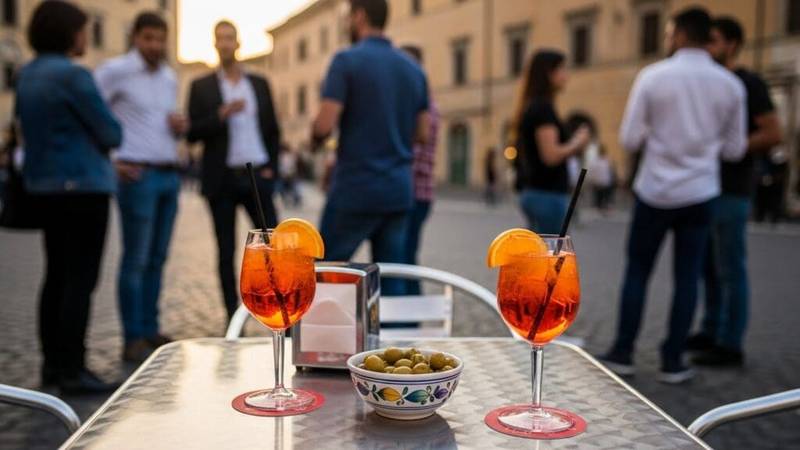
Because the goal is to open, not to fill, the choices are deliberate.
- The Drink: It should be dry or bitter, never sweet or heavy. A Spritz, a Negroni, a vermouth on ice. Bitterness stimulates the palate and signals that dinner is on the horizon.
- The Food: Olives, nuts, chips, perhaps a few small bites—cicchetti in Venice. You may taste them, but you are not meant to eat dinner here.
Cultural Truth: The Social Main Course
Stand near a piazza at 6:30 PM and the intention becomes obvious. Glasses are small. Plates are modest. Conversation is abundant.
This hour isn’t about intoxication. It’s about transition.
Rule: Aperitivo opens the appetite—it must never close it. If you leave full, you’ve missed the point.
Aperitivo washes off the dust of the day. It prepares you to arrive at dinner—and at the table with others—present, awake, and ready to share the evening.
Dinner: Slower, Lighter, Shared
(8:00 PM – 10:00 PM)
In America, dinner is often treated as the main event—the largest meal of the day, eaten late, fast, and tired. It’s where we finally stop working and try to refuel what’s already depleted.
In Italy, the logic is reversed.
Lunch has already done the heavy lifting. It fueled the body for labor and movement. Dinner carries a different responsibility. It doesn’t need to power work.
It needs to support connection.
Because of that, dinner unfolds differently than lunch. It stretches. It breathes. It’s governed less by the clock and more by the people at the table.
The Timing
To eat dinner at 6:00 PM in Italy is to eat alone—or with other visitors. Many restaurants don’t even unlock their doors until 7:30. Eight-thirty is standard. Later still in the summer, and almost everywhere in the south.
That late hour shapes the meal itself. You can’t eat heavily, aggressively, or carelessly right before bed. The structure naturally softens.
How Dinner Differs from Lunch
Menus may look similar on paper, but dinner is ordered with a lighter hand.
- Lighter Structure: It’s common to skip the primo entirely and order a secondo—fish or meat—with vegetables. Pasta is not mandatory. Fullness is not the goal.
- Regional Rhythm: In the north, dinner often leans toward lighter proteins and vegetables. In the south, it may mean a shared pizza—a food that, culturally, belongs almost exclusively to the evening. See our blog about authentic food and wine in Sicily.
- No Rush: Lunch ends when work resumes. Dinner ends when the conversation does.
Rule: Dinner feeds relationships more than hunger.
The food still matters—deeply—but it functions as a vehicle. What’s being nourished now isn’t productivity, but presence.
The restraint at dinner is social. You wait until everyone is served. You pour wine for others before yourself. You stay seated long after the plates are cleared.
Dinner isn’t about replenishing what was lost during the day. It’s about tending to what holds the day together.
The Ending: Closure and Balance
(After Dinner)
In the United States, meals often end abruptly. The check arrives, the card is run, and the table empties.
In Italy, the ending of a meal is its own deliberate phase. It isn’t an exit—it’s a closure. The intention is to settle both the stomach and the mind before the night continues.
The Sacred Sequence: Dolce, Caffè, Digestivo
There is a precise order to how a meal concludes, and it’s rooted in function rather than formality. Visitors often try to order coffee with dessert. This causes momentary confusion, because espresso isn’t meant to accompany sweetness—it’s meant to erase it.
- Dolce (Dessert): If dessert is ordered, it comes first. Light, measured, and complete.
- Caffè (Espresso): Only after the dessert plates are cleared. Espresso acts like punctuation—it closes the sweetness and signals the end of eating.
- Digestivo: The final seal.
The Role of the Digestivo
A digestivo—amaro, grappa, limoncello—is not “one more drink.” It’s not a nightcap in disguise.
It’s functional. Bitter, herbal, or high-proof, these spirits exist specifically to assist digestion and restore equilibrium after a meal.
(For a deeper look at how Italian spirits fit into the broader rhythm of dining, see our Wine Guide.)
Rule: A meal ends when balance returns. The digestivo is simply one of the tools that helps you get there.
Sometimes fresh fennel appears at the table to cleanse the palate. Sometimes it’s just the espresso. What matters is intention.
You don’t leave the table heavy. You leave it finished.
The Larger Truth
Italian food culture is often mistaken for indulgence. Look closer, and you’ll see something else entirely.
It is a culture of sequence. Recognized by UNESCO as part of the Mediterranean Diet’s intangible cultural heritage, this way of eating isn’t just about ingredients, but about the social and temporal framework surrounding them. Nothing is random.
The day moves in a deliberate direction: Light → Substantial → RestrainedWork → Pause → ConnectionHunger → Nourishment → Digestion
Nothing is accidental. Every rule—from the cappuccino cutoff to the order of the courses—exists to support the body’s natural rhythm.
To eat like an Italian doesn’t require moving to Rome. It requires moving through your own day with awareness.
It means respecting hunger enough to wait for it. Allowing meals to be anchors, not interruptions. Understanding that restraint isn’t denial—it’s preparation.
It isn’t about eating faster or slower. It’s about eating in rhythm.