
What Is Considered Small Group Travel? Why Group Size Matters

In 2019, I hosted 27 guests through central Italy, and that trip changed how I think about small group travel. It was a good trip, but 27 people meant we had to plan differently.
On our first evening in Rome, light rain followed us past the Colosseum on the walk to dinner. We counted the group and came up one person short. Nobody was lost. One guest was simply farther back at a crossing.
That moment stayed with me because it showed the real issue. Group size is not just a number on a sales page. It changes how much time goes into access, meals, vehicles, hotels, and keeping everyone together.
Key Takeaway: There is no universal small-group number, but 8 to 14 guests is a practical boutique range for food and wine travel.
What Counts as Small Group Travel?
Tour companies use the phrase in different ways. Some small group tours run in the low teens, while others carry 20 or more travelers.
After hosting trips from two paying guests to 27, I use a simpler test. Ask what the group size allows the operator to do once the trip starts.
For our European trips, 10 paying guests is the sweet spot. Jamie and I travel with the group, so that means 12 people together. Our normal maximum is 12 paying guests, or 14 with both of us.
Mexico is smaller. We sometimes host only two to four paying guests there, which creates a total group of four to six with Jamie and me.
| Group size | Travel style | What usually changes |
|---|---|---|
| 2 to 6 | Private or nearly private | More control, flexibility, and direct host time |
| 8 to 14 | Boutique small group | One-table meals, smaller wineries, easier transport, and strong social energy |
| 15 to 20 | Medium group | More limits begin with restaurants, vehicles, and smaller properties |
| 24 to 30+ | Traditional escorted group | Larger coaches, more structured stops, and more time spent on group logistics |
A group of 30 is still smaller than a 50-person coach. That does not make it intimate. The useful question is what the number does to the trip.
Key Takeaway: For food and wine travel, 8 to 14 guests is a useful boutique range because the number still fits smaller venues and shared experiences.
Why 10 Paying Guests Is Our Sweet Spot
Jamie and I have visited hundreds of wineries across six countries over more than 20 years. We have also hosted groups as small as two and as large as 27.
Ten paying guests gives us enough people for a social table without turning the trip into crowd management. People still meet other couples, but they do not disappear into separate clusters.
At 12 total people, including Jamie and me, I hear most of the table during dinner. I also notice when someone needs help before a small problem turns into a trip problem.
That balance matters on small group travel because hosting is part of the product. A smaller head count gives the host more time to read the room.
Key Takeaway: Ten paying guests gives us social energy without losing the personal attention that makes a hosted trip feel hosted.
Group Size Determines Where You Can Go
An 18-seat Mercedes Sprinter reaches places a full-size coach does not. That difference has changed our plans in Italy more than once.
Vehicle Size Changes the Itinerary
On our 2019 central Italy trip, the coach could not pass through the narrow arch near Sergio Mottura’s winery. Sergio and Sebastiano helped shuttle guests in personal cars, three at a time.
It became a funny story later, but the lesson was serious. A larger bus often forces the itinerary to follow road access instead of producer access.
We have seen similar issues in the Euganean Hills, where tight mountain turns slow a bus. Castelbuono in Sicily gave us another example when parked cars had to move.
With 10 paying guests, Jamie, and me, an 18-seat Sprinter gives everyone room for luggage without filling every seat. That extra space matters on longer drives.
Small Wineries Have Physical Limits
Many family wineries do not have a visitor center built for 30 people. Some do not have a formal tasting room at all.
I explain that model in Wine Tasting in Italy: Why Some Wineries Don’t Want You.
A cellar table often seats 10 or 12. One small restroom often serves the whole property. A working winery has room for a few guests but no place to park a large coach.
Once a group reaches 24 or 30, the operator needs properties built for larger groups. That usually means larger parking areas, scheduled tours, and bigger tasting rooms.
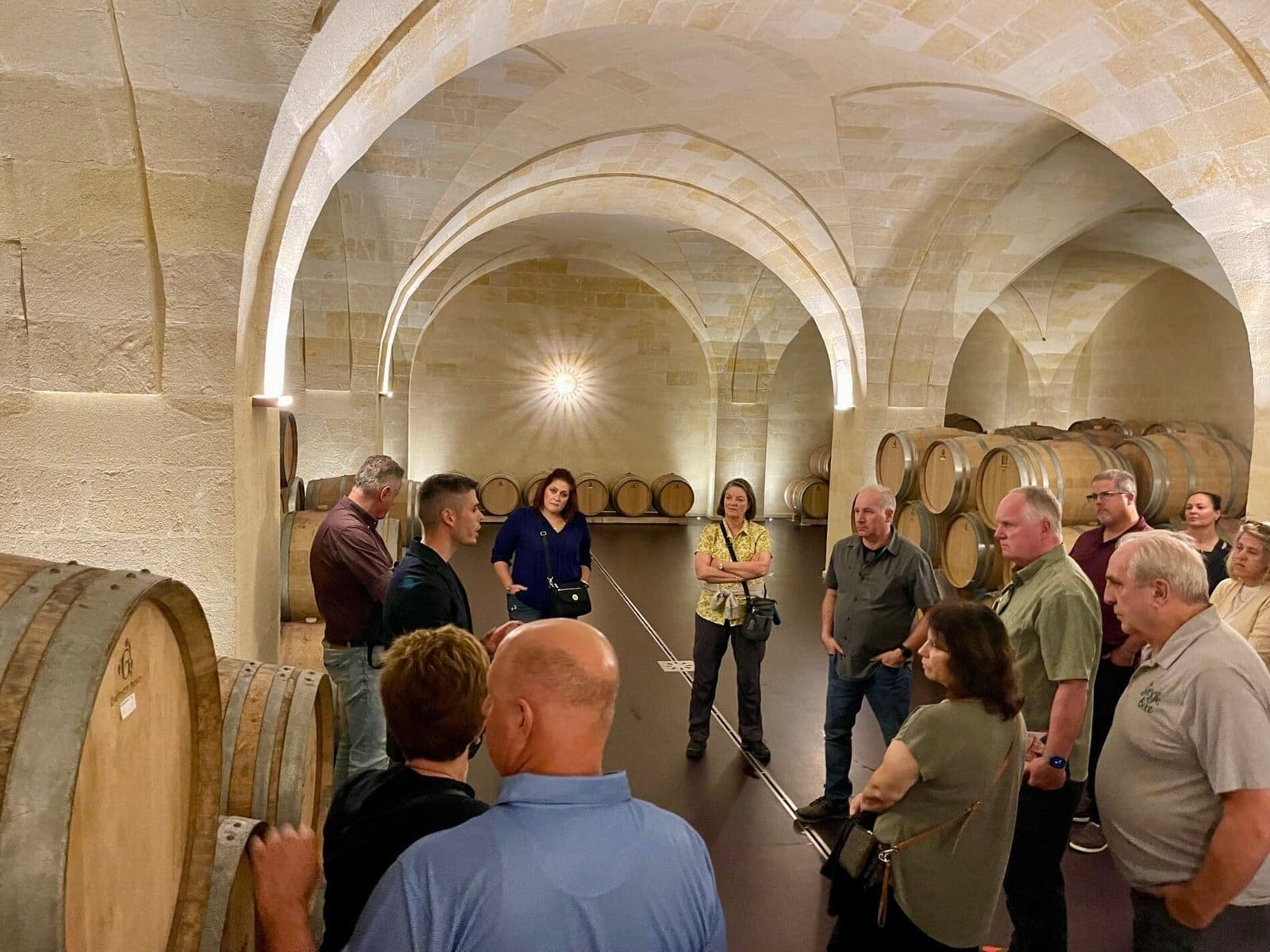
Those wineries offer a good experience. They simply offer a different one from sitting with an owner in the room where the wine is made.
Group size is a practical ceiling. It decides which doors stay on the itinerary.
Key Takeaway: Small wineries, narrow roads, limited parking, and cellar tables create real access limits long before marketing language does.
One Table Creates a Different Kind of Meal
As a chef, I notice group size most clearly at dinner. A table of 12 behaves very differently from three tables of 10.
With 10 paying guests plus Jamie and me, we often sit together. Bottles move across one table, we share dishes, and one conversation includes everyone.

France has made this point for us more than once. We have eaten in dining rooms that could hold about 14 people total. A group of 20 would not fit.
At 20 or 30 guests, some restaurants decline the booking. Others split the group, simplify the menu, or structure service around speed.
That changes the restaurant list. The operator starts asking who will feed the group instead of who will give guests the meal that best fits the region.
This is one reason small group wine tours often feel different from larger escorted trips. The number affects not only where you taste wine, but where you sit down for dinner.
Key Takeaway: One-table dining keeps meals social and gives an operator more restaurant choices than a group split across several tables.
What Genuine Winery Hospitality Looks Like
At Le Fraghe in the Bardolino wine region, Matilde Poggi once welcomed about 10 of us around one long table after showing us the vineyard and winery.
She poured several wines, then moved between the table and the kitchen. Charcuterie, cheese, and pasta followed. It felt like a producer hosting guests, not a timed tasting slot.
I tell more of that visit in the full Le Fraghe story.
That table could not have held 30 people. More important, cooking the same meal for 30 would have turned personal hospitality into a catering job.
In Provence in 2025, we arrived at Château de Roquefort with 10 guests. A pot of pot au feu was waiting, along with a fire and a homemade pastry.
The setting mattered, but the scale mattered too. Ten guests could be welcomed into that space without changing the way the hosts wanted to receive us.
Château de Campuget gave us another version of the same lesson in 2025. Franck-Lin Dalle invited our group to taste, dine, and stay at the property.
We changed hotels while we were still inside the cancellation window. That decision gave the group a private dinner inside the château, with food prepared by Franck-Lin’s sister.
Luxury small group tours should not be judged by thread counts and polished lobbies alone. Access, host time, and the ability to change plans matter more.
Key Takeaway: A small group does not guarantee special access, but it makes personal hospitality easier to offer when the relationships already exist.
Small Group Travel Is About Relationships, Not Just Numbers
A 10-person group still has an ordinary trip without the right relationships. The operator needs real relationships as well as a smaller vehicle.
On our early hosted trips, we sometimes used a destination management company to book winery visits. I supplied names of producers I knew, but the DMC made the bookings.
At Tenuta Santa Maria, Giovanni asked me a simple question after we arrived through that system: “Why didn’t you message me directly?”
He had already visited my restaurant and invited us to the winery. Direct contact would have saved time and given him a chance to plan something more personal.
That conversation changed how I build trips. I now start with the people and producers we want to visit, then I study drive times, hotels, meals, and transport.
That producer-first process is also how I explain how wineries are chosen for wine tours.
For Catalonia, Valentí Llagostera of Mas Doix told me not to use the public booking page. We would arrange the visit directly because our group would be his guests.
That is the difference between a reservation and a relationship. Group size helps, but relationships decide what the smaller group actually experiences.
I explore that idea further in The Truth About Wine Vacations.
Key Takeaway: A small head count creates room for access, but producer relationships determine whether that access becomes personal hospitality.
Is Smaller Group Travel More Expensive?
It usually costs more per traveler to operate a trip for 10 people than for 30. The driver, vehicle, planning, and host time are spread across fewer guests.
That does not mean the higher starting price is automatically worse value. It means travelers need to compare what each price actually includes.
Before you compare two trips, check at least these items:
- How many lunches and dinners are included?
- Are wines with meals and winery tastings included?
- Are gratuities, transfers, and private transport included?
- Are key activities included or sold as optional excursions?
- What hotels and room categories are named?
- Do the same hosts stay with the group throughout the trip?
A lower base price rises quickly when meals, wine, transfers, and gratuities sit outside the package. A higher price is still poor value if the details do not support it.
The fair comparison is not cheap versus expensive. It is one complete experience versus another complete experience.
For a deeper cost breakdown, see what luxury wine tours are really paying for.
Key Takeaway: Smaller groups often cost more per person, so compare the full package of meals, wine, hotels, transport, gratuities, and host time.
Questions to Ask Before Booking a “Small Group” Tour
A company may use the phrase small group without telling you the number. Ask for the number before you pay a deposit.
These questions reveal much more than the label:
- What is the normal number of paying guests?
- What is the absolute maximum?
- Are hosts and guides included in the advertised group size?
- What type of vehicle will the group use?
- Will the group normally dine at one table?
- Are winery visits private or shared with the public?
- Which meals, wines, tastings, transfers, and gratuities are included?
- Who designed the itinerary and knows the producers?
- Which major experiences cost extra?
- Do the named hosts travel with the group from start to finish?
If a company answers those 10 questions clearly, you judge the trip on facts. That is more useful than relying on the phrase “small group.”
Key Takeaway: Ask for the normal group size, the hard cap, the vehicle, and the dining setup before you compare price.
What Group Size Is Best for You?
A couple who wants full control often prefers a private trip for two to six people. That gives the most freedom to change timing, meals, and daily plans.
Travelers who want major sights and a lower starting price often prefer a larger escorted tour. Those trips cover more ground and remove most planning work.
For travelers who want social energy without a full coach, 8 to 14 is strong boutique territory. That range also works well for small group travel built around food and wine.
The best number depends on the experience you want. What matters is whether the operator’s group size supports the hotels, restaurants, roads, and producer access being promised.
Key Takeaway: Choose group size by travel style. Private travel favors control, larger tours favor breadth, and 8 to 14 balances social energy with access.
Frequently Asked Questions About Small Group Tours
Is 20 people considered a small group tour?
Some companies describe 20 travelers as a small group. In food and wine travel, 20 people already create more limits for vehicles, dining, and small wineries.
What is the ideal small group tour size?
For our hosted food and wine trips, 10 paying guests is the sweet spot. With Jamie and me, that creates a group of 12.
Are guides and hosts counted in the group size?
Not always. Ask whether the advertised number means paying guests only or everyone traveling together, including hosts and local guides.
Are smaller tours more expensive?
They often cost more per traveler because fixed costs are shared by fewer people. Compare meals, wine, transport, hotels, gratuities, and included experiences.
Is a small group tour better than a private tour?
Not automatically. Private travel gives more control, while a small group adds social energy and removes much of the planning work.
Key Takeaway: No group size is automatically better. The right choice depends on how much privacy, structure, social connection, and planning help you want.
What This Number Really Changes
After hosting two paying guests, 10 paying guests, and a 27-person trip, I no longer see group size as a comfort detail.
It determines the vehicle, the restaurants, the wineries, the hotel choices, and how much time the host spends with each guest.
For the kind of small group travel we build, 8 to 14 is the practical boutique range. Ten paying guests remains our sweet spot.
Key Takeaway: Group size sets the practical ceiling for transport, dining, winery access, hotel choices, and personal host attention.
If you are comparing food and wine vacations, use the VIP Insider Guide before you book. It shows what to compare beyond the price and the marketing label.
Inspired to travel deeper?
Explore the private wine, food, and producer-led journeys behind the stories on VIP Winery Vacations.
View Sicily


